Memoir by Rachel Held Evans
What, another memoir? I know, I agree, I wanted to read a novel next but this one was on my nightstand and overdue at our public library (which is super awesome and doesn't charge late fees, but I try to be an upstanding citizen and return books on time. I'm a guilt monger that way).
The title of this book is weird, but clearly explained in the opening pages. Rachel Held Evans uses the controversial word "evolve" to describe her idea that Christianity and Christians do and must change. Rachel grew up in Dayton, Tennessee, site of the Scopes Monkey Trial which debated evolution versus creation. She uses her proximity to this historical event as a springboard to discuss her personal evolution from a non-questioning conservative Christian to a question-asking, don't-label-me follower of Jesus without all the trappings that the postmodern church has instilled. She calls it a crisis of faith, but to me it seems more like a coming of age.
And that is the basis of my main reaction to this book. Because Rachel grew up in the Bible Belt amongst very conservative Christians, the ideas that evolution may be right, that homosexuality may not be a sin, that Jesus represents social justice as well as salvation...those were all foreign to her. Questioning what she learned as a child does cause her to have a crisis of faith, because she believed theology was more important than actual relationship with God. I didn't have that problem. I'm not saying I'm more enlightened, just lucky, I guess, that I have a background of God-first, rules-second kind of Christianity. Having a feminist Christian mother probably helps. And while I have developed some ideals of my own that are different from most of my family (I vote mostly Democrat now--gasp!), I would call that growing up.
A small side note on this book is that she takes a trip to India, which she clearly says is to visit her missionary sister despite the vogueishness of such a trip. It reminded me that Anne Lamott describes a visit to India in the last book I read, which reminded me of Eat Pray Love. Aren't those kinds of trends interesting in literature? Maybe I need to take a soul-searching vacation to write about.
Now for some book club business-y items (don't tune out, it's good stuff):
The novel I just started reading looks kind of intense, so it'll likely be a while before I'm done. If so, just to keep you interested, I may be posting the first few pages of MY novel. That's right, the one I've been hinting at writing. I just went to a conference where other writers critiqued my first page and I want to get some more feedback after I make revisions. Be on the lookout!
Also, a question for those of you who buy books for children or teens: how do you determine what is appropriate content for them? I struggle to find books that are at the reading level of my voracious, book-gobbling seven-year-old but still not too mature for her sweet little mind. I also recently lent Water for Elephants to a 7th grader, feeling a little hesitant about the sex scenes and drinking, but she was the one who recommended The Night Circus to me. This is a new issue for me, one I am feeling my way through, and I would appreciate any signposts you can put up for me. Thanks.
Love to read but too busy/lazy/tired/grumpy to leave the house? This book club's for you!
Sunday, May 19, 2013
Saturday, May 11, 2013
Some Assembly Required: A Journal of My Son's First Son
Memoir by Anne Lamott
First, prepare for gushing. Second, I am six and a half months pregnant (ok, six and a quarter--it's hot here and I need something to feel good about) so the timing of this book is apt. Third, you should know that Anne Lamott will be the first author I credit when I become a famous writer myself.
Now that you know those things, oh my goodness, I love this book. I love almost everything Annie writes (that's what she calls herself so I'm only taking small liberties). My favorites are her memoirs because they are refreshingly real and honest. This one, as the subtitle clearly explains, is on becoming a grandma. It's kind of a sequel to her book Operating Instructions in which she journals about becoming a mother when she was single, broke, and newly sober. I loved that one too. Now she's 55 and a her son, who is young, broke, and recently separated from his girlfriend, finds out he's going to be a father. They go through the year together, the four of them, Anne, Sam (the dad), Amy (the mom), and Jax (the baby), plus a rotating cast of hilarious and wonderful family and friends. They make my enormous extended family look small (and normal).
If you're thinking this has been done before, this blogging about baby thing, then you don't know Annie. She finds humor and irony and despair and joy all in the same poop anecdote. She turns diapers into major life lessons. She loves Jesus but says the f word. She's a hoot. Here's proof:
Top Five Quotes that Made Me Laugh or Cry or Say "Me Too!"
Amy and Sam despair at my underwear...they do not think I can ever get a boyfriend with underpants at like these.
The single most radical thing I know...is that I get to take care of myself. Of course, Sam and Amy get to take care of themselves, too; so this is not so great.
He seems to be in a workshop on the concepts of In and Out and Off. All the books on the shelves, Off. All the pony figurines in the box, Out. Then In.
Some people who shall remain nameless tricked me into loving them and ruined my life.
Sam called to say that Jax had held his bottle by himself for the first time. He's nearly ready for a paper route.
Does that not say it all? Anne Lamott is so wonderfully tongue in cheek, self deprecating, and reverently irreverent that she makes me want to stalk her.
Thursday, April 25, 2013
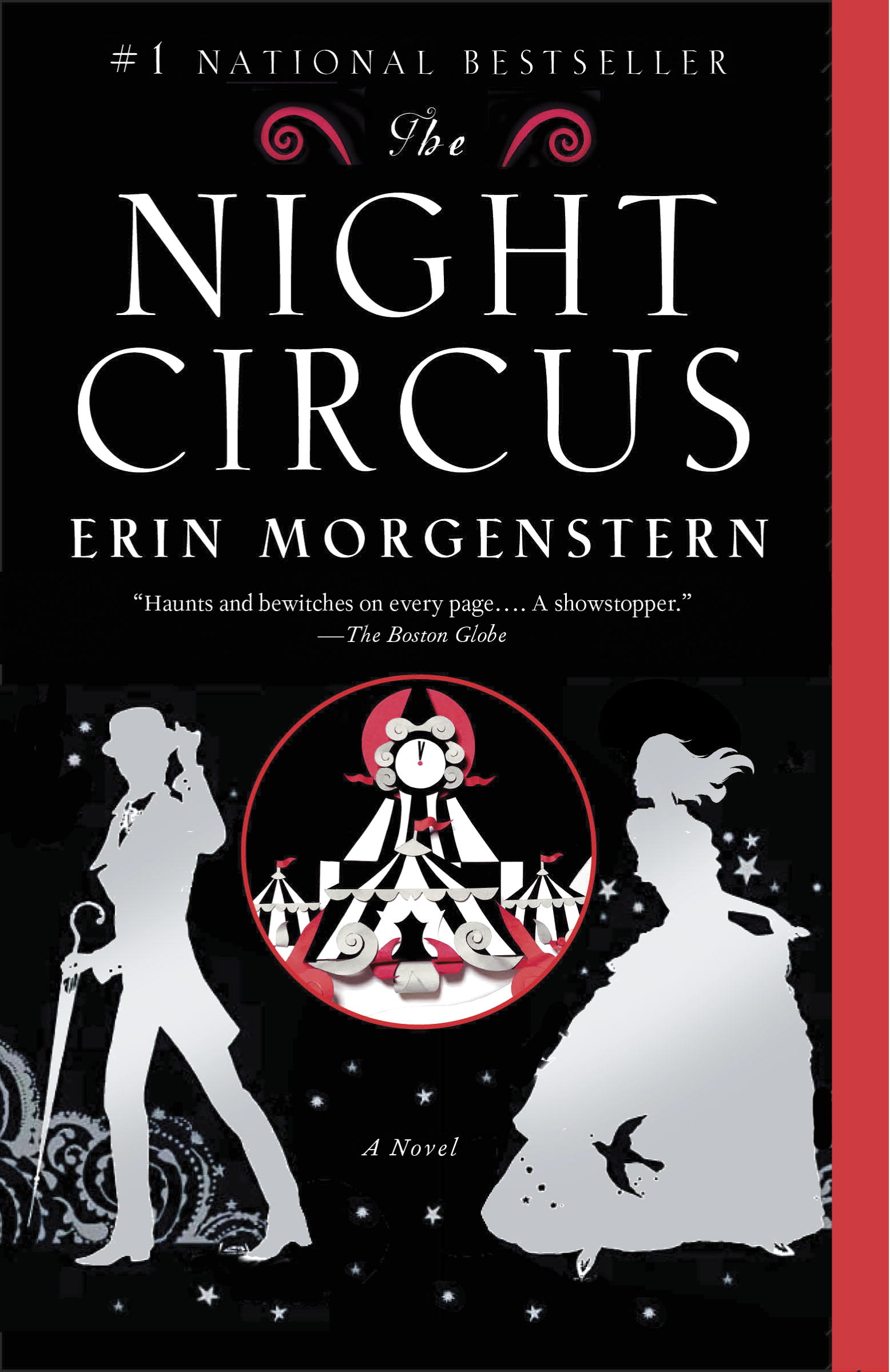
The Night Circus
This book is still a bit of a mystery to me.
Admittedly, I read it too quickly. I always do. And I skipped ahead to the ending when I was about halfway through. I usually do that, too. But it's more than those reader-errors that make it tantalizingly confusing.
The storyline jumps around in time, not like in a Kate Morton book with multiple narrators and time periods, but like The Time Traveler's Wife, where it's all about one story and one set of characters but shows their lives at different times. You really must read the chapter titles.
No wonder my middle school student, who recommended it to me, is having a hard time understanding it.
Put off? Wait--the good side of the mystery, the tantalizing part, is still to come.
Also mysterious to me are the descriptions of the circus tents. See, this is about a circus that performs only at night, doesn't announce where it is going next, and is actually run by two dueling magicians who eventually fall in love (no plot spoilers there--it's all on the back cover). So the circus tents sometimes contain amazing but expected circus acts, and sometimes reveal mystical experiences like a wishing tree lit with candles or bottles of scents from your dreams or a vertical maze leading into the sky. And it's real magic, very Harry Potter-esque. Oh, and it's all in black and white and gray, often looking like ice or snow or white fire or pages torn from books or folded paper. The descriptions alone are mind boggling. I can see why it's being made into a movie--it'll be a visual masterpiece. As a book it's hard for me to picture sometimes.
The book also constantly reminded me of something I couldn't quite put my finger on. There are obvious Shakespeare references, to Prospero the Enchanter and Hamlet and Romeo and Juliet. It also reminded me a little of Ray Bradbury's Something Wicked this Way Comes (which in itself is a reference to Shakespeare). And I've already mentioned The Time Traveler's Wife and Harry Potter. But there's more to it than that--it just seems very familiar and yet elusive at the same time. Like the mazes and illusions and charms in the book itself. It just turns in on itself constantly.
Yet I liked it. I was drawn into the mystery, I liked the right characters and hated the right characters (don't you just despise when there's no one worth loving or hating in a book?). It was a little slow in the middle but the end galloped along like a gryphon on the enchanted carousel. And all along the way it gives you a spine tingling sense of something...something...well, watch the book trailer at the bottom of Erin Morgenstern's website and you'll see what I mean.
Thursday, April 11, 2013
The Casual Vacancy
Novel by JK Rowling
See that image to the right? See how the picture of the author is firmly attached the image of the book?
That says it all.
If JK Rowling hadn't written this book, it would have gotten nowhere.
Like many Harry Potter fans, I was curious to see what her next book, especially an adult novel, would be like. And I tried hard not to judge it by the standards of Harry Potter. It's a totally different genre and audience, after all. But I saw quickly that even without comparing it unfairly to the genius world of Hogwarts, just by comparing it to other normal adult books I happen to like...I Hate This Book.
The title refers to the central plot, a forced election for an empty seat on a small town council in rural England, caused by the death of one of the town of Pagford's leading citizens, Barry Fairbrother. His last name is no coincidence--he's the only likable character in the book and that's probably because he's dead for all but a few pages, so he has no time to screw things up. Unlike his two best friends, his opponents on the town council, a woman secretly in love with him, and the teenage children of these adults, who all go out of their way to be inattentive, rude, or even cruel to the people they are supposed to love. The way the families treat each other is worse than the way the men running against each other for town council do. The plot is rife with back stabbing and sabotage, of both the election and their personal lives.
It's also completely about us versus them, teenagers versus adults, rich versus poor, liberal versus conservative. And as polarized as our nation is right now, I could have just logged on to Facebook to read that kind of vitriol.
And really, that's my main complaint: mean people. There's also lots of swearing, physical abuse, drug abuse, sex abuse, food abuse, suicide...not topics I enjoy reading about in such profound amounts. The few reviews I read that defended the book seemed to imply that some people are too squeamish and need to get over the swearing and get to the story. I can understand that; sometimes vivid characterization and realistic plots beg for a few swear words. Again, that's not my issue. I just don't like the characterization or plot. It's mean. It's depressing.
Bottom line: read if you're completely curious, which will be my motivation when I finally read Fifty Shades of Grey. But expect to be bummed out. And DON'T by any means let your Harry Potter fan kids read it. Just read a few pages and you'll see what I mean.
Saturday, January 5, 2013
The Forgotten Garden
Novel by Kate Morton
Kate Morton is emerging as one of my favorite writers. I have read three by her now: The Distant Hours, The House at Riverton and now this one. I also heard she has a new book out, The Secret Keeper. AND, I saw something online about this book becoming a movie, but nothing confirming.
I think what I like about Morton is her consistency. Her plots may seem a little bit the same: families in England go back generations to discover family secrets of love and betrayal. Specifically in this one, a young woman in Australia inherits a cottage on the Cornish coast of England and travels there to find out why her grandmother was put on a boat to Australia as a young child, essentially abandoned. The plots never fail to have a twist at the end, despite heavy foreshadowing that makes you think you have it figured out. If you remember, I complained about the foreshadowing in the last one, but it was a touch lighter here.
When I read now, I am often thinking as a writer as well as a reader. I think the plots help me lose myself in the story, but what pulls me back into my own head here is the description. I think Morton has a failing I see in my students: overuse of the thesaurus. There are times when she uses a sort of high-falutin' word when a simpler one would have done. I mean, titivating? perspicacious? Maybe I'm just grumping because I had to look those words up, but I also doubt the character's actual use of those words. I want to see the scene through the character's eyes, not the writer's, or I lose focus. Also, she often applies these types of words to long descriptions of the scenery. Granted, I need help picturing the Cornish coast, and a British antipodean garden (had to look that one up, too), but there's only so much of that I want to read.
I guess my question here is: how much description is too much? As a reader, I often skip paragraphs of description to get to the meaty plot parts. But I appreciate a well-turned phrase that really puts you in the scene, too. What do you think? How much setting description do you like?
Friday, December 21, 2012
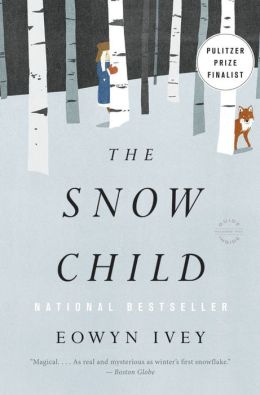
The Snow Child
Novel by Eowyn Ivey
I should mention that I just this second finished reading this book, and I wish you were sitting with me in my family room under my Very Hungry Caterpillar quilt to talk it over with me. And I wish that you would have brought cheesecake. But cake aside, I really want to talk about this book, so I will be forcing it into the hands of my dear friend and book-soul-mate, who is visiting for New Year's. I could talk about it with my mom, who gave it to me, but she's probably already read three other books and forgotten what this one is about. So for now there is you, dear book club friend, even if you have not yet read it.
The Snow Child is a fairy tale for adults, set in Alaska in the 1920s. An older couple, childless and sad, has come to farm the wilderness and escape from their sadness. We all know that doesn't really work, except that they make a few new friends, and one crazy night, a snow girl, who becomes real. Maybe. Or maybe she's an orphan surviving alone in the woods. Either way, she saves them and they care for her. Part (dare I say it) magical realism, part Jack London story, totally engrossing.
There is something haunting in this book. The descriptions of the animals as both vividly beautiful and as meat get under my skin. It's so raw. There's also an element of foreboding the whole time; I was holding my breath waiting for something bad to happen. Maybe it's the foretelling of the snow girl's fate at the beginning of the book, or the harsh reality of the Alaskan wilderness. I also noticed about halfway through that the regular dialogue is punctuated normally, but all dialogue with the snow girl has no quotation marks. It's unsettling, like having conversations in your head. My mom said she read this book at our family's cabin, but I'm glad I read it here at home with my large, bat-wielding husband nearby. It's beautifully creepy and invokes the cabin fever that is mentioned frequently. I would guess that tone is intentional. Worked on me.
Interestingly, there is an element of this story that echoes the last book I read, in the examination of motherhood. Both the birth of a child and the loss of a child in this book change who the women are, both in the roles they play and in how they identify themselves. It's a theme that comes up so much in what I read, as does the loss of children and pregnancy in general. I think women are striving to make sense of who we are, with and without children. How it's handled is so different book to book, though. There are some books with pregnancy loss that I would NEVER recommend to a pregnant mother but this one I would. The loss isn't the central story, and there is redemption in it as well.
BTW--do you think the author's name is pronounced like that girl warrior in the Lord of the Rings books (which I have never read, much to the chagrin of my husband)? If so, she must be pretty badass.
Thursday, December 6, 2012
To Die For: A Novel of Anne Boleyn
Historical Fiction by Sandra Byrd
Fair warning: I can't say anything bad about this book. I met the writer so now it's personal. It would be like saying my friend's baby wasn't cute (and I really mean that only as a metaphor, friends, your babies are all cute).
Last month my mom invited me to a book talk at our public library, where Sandra Byrd was promoting her newest book, The Secret Keeper: A Novel of Catherine Parr (Henry VIII's last wife), which is sort of a sequel to this one. Sandra showed a very informative slideshow about the Tudors and then took questions, at which time my mom proceeded to embarrass me by telling Sandra I was writing a novel, and then make up for it by buying me two books. I'm easy that way.
So this is the first in a series of three she calls the Ladies in Waiting Books, about Tudor queens (the next one due out is about Queen Elizabeth, who was Henry VIII and Anne Boleyn's daughter). They are all from the perspective of a historically real but little known lady in waiting for the queen of the day, this one being Meg Wyatt, best friend to Anne Boleyn. I got kind of tired of Anne Boleyn after the hype about The Other Boleyn Sister but this book is refreshingly different. That's because it's not from the point of view of the royals, and because there is an element of faith interwoven into Meg's story, and because even though Anne dies, there is a happy ending for some.
What I thought about most while reading was the element of childbirth in the story and in women's lives at the time. So often in the book, a woman's fate depended on whether she had borne children. Some were shunned for being unable to have children. Some had to marry a despised man because their children would join two great estates. Some just plain died in childbirth. In Anne's case, she was beheaded because she didn't have any male children. I am thankful today that my marital and financial future don't depend on my children or their gender, but still. I think for women today there is still the sense that our lives rise and fall based on our ability to have children. As I was discussing with a friend recently, some of us are desperate to have children and can't, some are having children when they are unprepared, and some experience both in the span of just a few years. Our lives are tied to our fertility still, five hundred years after this story occurred.
Sorry if that was a little heavy. I'll try to read something with less death and destruction next time. And by the way, I got the message: there will be no more book club posts about Rick Riordan books. The more I post about him, the fewer readers I have. Sheesh.
Subscribe to:
Posts (Atom)