Friday, December 16, 2011

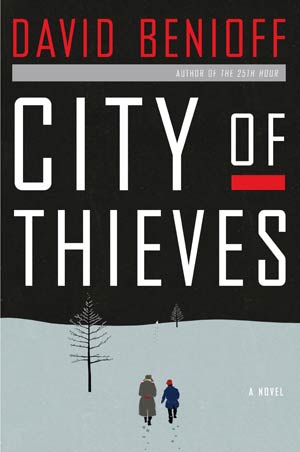
City of Thieves

Novel by David Benioff

Yeah, it's been a long time since I've posted, which means I'm not exactly flying through the books. Too many Christmas cards to address and magazines to read, and not enough books I'm really loving. The most recent was another dubious find from library book club section. This fictional take on the historical siege of Leningrad during World War II is engaging and horrifying at the same time. It combined some of the things I love about a story with many of the things I hate.

The book starts off in one of my favorite ways: with a frame. It's narrated initially by a young American writer interviewing his grandfather, who then becomes the narrator, like in the movie version of The Princess Bride. The grandfather then tells of his experience as a young man, being commanded by a powerful Russian general to find a dozen eggs in the nearly foodless, blockaded city of Leningrad. I love this approach because it's like two stories in one.  By the time I got to the end, I had forgotten about the grandpa from the beginning, and realizing he was the one living through the story was like experiencing it all over again.

I also enjoyed reading about Leningrad in the 1940's and Russian culture in general--I only really know about Russian culture from movies (embarrassing ones like Anastasia) so I learned a great deal. And for some reason, books about WWII continue to attract even this generation. I found myself thinking about that while I read and wondering if 9/11 would ever have the same kind of powerful place in literature and movies. Anyway, the historical fiction element, plus a sweet ending, made this book sort of enjoyable.

The downside, though: I literally had to skip whole pages because of the violence and end-of-the-world type of activities of the characters. Death is everywhere, from starvation, cannibalism, cold, guns, bombs, dogs...and the characters go back and forth between disgust, mourning, and nonchalance as they are constantly stepping over dead bodies. I hate how cynical and paranoid this kind of stuff makes me feel. It makes me want to become a hoarder. I don't like it.

So you have to make your own decision (as always): does the good plot, transportation to another world, and engaging characterization outweigh the desperate, wormy feeling that some scenes will give you in your tummy? The choice is yours. But my choice is clear: when I go to the library with my daughter during Christmas vacation, I must not check out any more books. I need to read the vast pile on my night stand of books actually recommended by someone I know and trust, not ones that I judge by the cover. Mmmm, Isabel Allende...

Sunday, November 13, 2011

Fever 1793

Young Adult Fiction by Laurie Halse Anderson

I love the YA genre. I get to pretend that I read these books on behalf of my middle school students, but the truth is that they are so refreshing. They're easy and quick reads, for one, but they are also exactly what they promise, with only the expected surprises. After reading two suspense novels, the last of which tried oh-so hard to be cool, it was nice to open a book that looked like historical fiction about yellow fever in Philadelphia in 1793 and find that's exactly what it was. It reminded me of an American Girls novel, with a sweet young narrator who is focused on boys, chores, and fun in her post-colonial world. The fact that something is wrong with that world is hinted at on the second page, and the fever strikes on page 13. It's not just young readers who like a story that gets right to the point. And, of course, this has the setting in another time and place that I love, and the satisfying ending I absolutely need. I hate to be left wondering.

I am left curious about this author, however, and feel I need to read more of her work. She has another YA book called Speak that was something of a controversy at my school's library a few years ago. Speak is about the rape of a teenager. That's all I know about it so I can't say where I land on the controversy but now I want to read the book and see.

By the way, I found this book in the young adult summer-award section at the public library. It is a GREAT source for books for teens--it's divided into two age categories and winners are picked by kids, not adults. I've liked every single one of the books I read from this list, and really loved a few.

Side note: After Fever 1791 I started a book called The Tortilla Curtain (also a find from the library, but the adult book club section).  About 20 pages into this book about a relationship between a posh California couple and Mexican immigrants, I realized something sounded off. I checked the publication date and it's 1995. No thanks. This may be a current issue still but I don't want to read someone's take on it from 16 years ago. Guess I'll just miss out on this one.

Monday, November 7, 2011

The Yiddish Policeman's Detective Club

Novel by Michael Chabon

Two things:
1) Dang, I am a sucker for the book club selections at the library.
2) This is my first rant about a book on the blog.

So I picked up this book because the title was intriguing (see previous entries about my love for books set in other places). However, I had to Google the book and author to even figure out what was going on in the first few pages. Because for one thing, I know no Yiddish, which is sprayed all over the pages. And for another, the book is set in a fictional world that sounds real but makes you question your sanity. A Jewish state in Sitka, Alaska, that was settled after the new country of Israel was disbanded? Those things are not real. So I figured out. It's actually kind of a genius way of writing, getting to make up your own history but in a real world setting. And Michael Chabon is apparently kind of a genius author, but way too high brow for me. And, final straw, I hated the ending. It basically doesn't have one. So I threw the book across the room (you're welcome, Stefanie Johnson).

A few good things about the book are the characters and family relationships: everyone has known everyone forever or is related to or was married to everyone, so the back story is rich. Also the metaphors and imagery are amazing. I sometimes get tired of too much description and Chabon uses metaphor in about every line, but some of it is so real and just right. There's the pretty stuff, like "A badge of grass, a green broach pinned at the collarbone of the mountain." But there's also some dry humor, like the way it feels to ride in a very small airplane in turbulence: "All the pins and bolts came loose from Landsman's skeleton, and his head got turned around backward, and his arms fell off, and his eyeball rolled under the cabin heater." So great. I wish I could write that. But if I could, I'm pretty sure I'd put it in a book with a real ending.

Sunday, October 2, 2011

The Redbreast

Novel by Jo Nesbo

I don't know why I read this novel. It came in the mail from the library, and I can't remember if I requested it for myself or for my husband. I vaguely recall reading a review in the newspaper, but not what exactly about it intrigued me. So as I dug in, repeatedly asking myself, "Why am I reading this?" I thought this would be my first post about a book I didn't like. But I guess I'm a bit of an easy audience.  The book ended up being totally absorbing and may start a new trend in my reading: European mystery novels ("The Girl Who... ", here I come.)

So this novel was written in 2000 and is the third in a series, but I'd never heard of it because it was only translated into English in 2006. It has won several awards, including one aptly named "The Best Norwegian Crime Novel Of All Time." How's that for specific? The book follows a detective named Harry Hole (not aptly named), a recovering and sometimes relapsing alcoholic, as he investigates a series of murders involving modern Neo-Nazis and former Norwegian soldiers who fought for Germany in World War II.  For a serial book, this one starts off right in the middle of the action and catches you up on the essentials of the characters when you need to know. In fact, if it didn't keep mentioning something that happened in Australia, I wouldn't have known it was part of a series. The author also uses that style of jumping back and forth in time and point of view, for which I am a complete sucker. Because this is a mystery, I would just start to think I was figuring something out, and then the setting would change in the next section and I would lose my ideas. I re-read the opening sequences of this book three times, and the final time I found some subtle foreshadowing about the way the mystery is solved.

Also, this is another example of a book teaching me about culture and history.  My heritage is Norwegian and I thought I knew a good deal about Norway, but apparently not as much about current Norwegian culture, and nothing about Norwegian involvement in World War II. That part of the book reminded me of "A Very Long Engagement," which is about World War I but also centers on the confusion of the trenches and missing soldiers. The two books are incredibly different in other ways, but both transport me to another world. There were some downsides in that for this book, however, mostly because it was written for a Norwegian audience. There were official acronyms I didn't understand and lots of cultural references I didn't follow. Plus there was some really weird wording at times, and I'm still not sure if it's the way Nesbo writes or the way it was translated.

I will likely be reading more Harry Hole and Girls Who Kicked Stuff in the future (even if that sounds creepy). But not right away, because I've noticed my severe lack of non-fiction reading lately. I read three memoirs in June and nothing but novels since then, so I'm going back to The Duchess to give her another try. And I've also got the newest Isabel Allende whispering to me in seductive Spanish accents from my bedside table. But I'll get back to the Scandinavian crime dramas sooner or later, because this one was very intriguing and a nice break from my norm.

PS- Do you like the new design? I like that it fills the screen more. Less scrolling.

Sunday, September 11, 2011

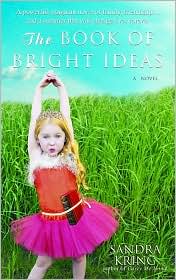
The Book of Bright Ideas

Novel by Sandra Kring

I have a book confession to make...I often read the last few pages of a book. Not right at first, but after I'm a few chapters in. I mostly want to make sure that nothing really terrible is going to happen to the characters that I'm coming to love. Or at least be prepared for something terrible if it does happen. And there is just something about Sandra Kring's books that fills me with dread that something terrible really might happen. Maybe it's the time period (late 50's to early 60's), or the creepy characters she throws in, or the extreme innocence of the main characters. But I really had to know with this one. And I definitely found out more than I was expecting. There is a plot twist near the end that really threw me, and then the end itself was not at all what I expected. But I think that's part of the appeal of this book; it's all about changes.

This is another novel by Kring (see How High the Moon from July's post) that is narrated by a little girl. Evelyn (called Button) is nine and has big ears, literally and figuratively, so as readers we hear lots of adult stuff as well as a nine-year-old take on the world. The misinterpretation of things she hears is charming, and nostalgic, and also a little heart breaking all at once. I think it's an ingenious way to tell a story. We get to hear Button explaining her excitement about a new girl who moves into the house across from Button's aunt, where Button spends her summer days while her mom is at work. Button makes it clear, without even seeming to realize herself, that her aunt is where she gets her loving, and her own parents don't exactly know how to show her their love. We also hear from Button the adult's opinions on the wild little girl, Winnalee, and her wilder older sister, Freeda. Again, Aunt Verdella accepts and loves the new girls, while Button's mom judges them. The overheard conversations are enlightening to both Button and the reader.

In both books I've read by Kring (recommended by my friend Marie), there is a clear disdain for any pretension. The characters who try to seem like they have it all together are really the messy ones inside, and the dirty or poor or in this case slutty characters are the ones who have the wisdom. As do the little kids. It's the young girls who create the Book of Bright Ideas, a list of witticisms based on their experiences. The ideas in the book are both hilarious and so true. And they reveal what's really important. As a teacher and a mom, I know that I don't have a handle on everything in life, but I try to look that way with my clean house and checklists on the fridge (truly: there are five). But the real fun and love in life and in this book is when the characters stop striving for perfection, and let the kids decide what's for dinner, or go dance in the rain in their underwear. That stuff is hard for me. And I actually have a lot more in common with the characters that Kring presents as stuffy and fake--but in this book those characters have a chance to change. I don't think I'll be stripping off and running outside next time it rains, but reading stories like this remind me to have fun and play more.

Friday, September 2, 2011

Dreams of Joy

Novel by Lisa See

I don't know what it is about me right now, but I keep reading books that I start out thinking, "Meh" and then they creep up and grab me! Maybe it's that my attention is being pulled in so many other directions (new baby...new school year...new kindergartener). But man, this book started kind of slow and then bam, grabbed me. 

Lisa See is one of those authors whose books I always read. I haven't loved them all, but I read them all because the great ones (Dragon Bones, Snowflower and the Secret Fan) are worth slogging through the just-ok-ones (Peony in Love). Her writing style is very clear, bordering on obvious, and sometimes a little repetitive. You always know everything a character is thinking and feeling, even when it's not entirely consistent with the image you have of them. But that also makes them very real, and pretty relatable. And she writes about ancient China or Chinese immigrants, which means I learn about another culture or time. Love it. 

Dreams of Joy is a sequel to Shanghai Girls. I think the book started slow for me because it incorporates some review of the previous book (which I've read) at the beginning.  But I also really like that DoJ picks up THE MINUTE SH leaves off. You don't get many sequels that do that. Also, the narration of the story is shared between a mother and daughter, and as both a mom to a girl and as an adult daughter, I appreciated the nuances of the relationship. The book takes place in the late 1950's, as Joy, the daughter, finds out some nasty family secrets and runs away to find her biological father in what has become Communist China. Joy's mom follows and the two live in China for a few years, through the highs and lows of the new government and society. The experiences Joy has while living in a farming commune are really what grabbed me about this book, plus the relationships that Pearl rekindles in the city where she grew up.  Then the story intensifies during a famine and becomes almost unbelievable, including something called "swap child, make food." But I Googled it--it's historical. It's horrible, but very engrossing. 

I like to think that books like this can make me a better teacher of history, but honestly, I teach middle school--it's not really going to get this detailed.  Maybe I understand more of the general ebb and flow of world history and culture. But mostly, I love the characters, how their culture has shaped them, the surprising ways that people like Joy and Pearl can change.  And I'm a sucker for a happy ending.

Next up: The Book of Bright Ideas by Sandra Kring or Heaven is for Real by Todd Burpo (time to mix it up with some non-fiction).

Wednesday, August 10, 2011

Children and Fire

Novel by Ursula Hegi

This was a gut-wrencher. I totally enjoy books that cause me to think about issues or reflect on myself, books that teach me to look inside and outside myself. But this was a toughy. The book is ostensibly about a small town in Germany during the rise of Hitler, but what it's really about is a woman struggling to understand who her family really is and what she's all about. Oh, and someone dies.

Uh-oh.

I think I've just found the first problem with an online, one-sided book club. You may not have read this book, and you might want to read it in future. So you don't know who dies. And I shouldn't tell you. Crap.

Ok, I'm going to dance around it, but you'll probably figure out who it is if you read this very carefully. So if you want to read the book and don't want a plot spoiler, stop now.

So anyway, Children and Fire is part of Ursula Hegi's Burgdorf Cycle, four books about this little town and its people. The first, and in my opinion best, is Stones from the River.  All the books in the cycle contain some of the same characters, but focus on different people or different years. One thing I find interesting is that none of the characters are particularly lovable. They're just all very real. Which is one way that Hegi is a phenomenal writer. She teaches writing in a masters program in New York, and I think being her student would be both inspiring and intimidating. Because another thing she does very well in her writing is weave these incredibly rich and complicated tapestries of stories that seem to be about one thing but really are about so much more.

For example, the title. There are children in this book, and there are fires. The main character, Thekla, is a teacher, so it would make sense that the children would be her students, which they are. The foreground plot takes place all within one day in her classroom. But the story also loops back to Thekla's childhood memories of her family, so she and her brothers are the children in the title as well. The omniscient narrator tells us more about Thekla's childhood than she knows, such as the fact that her dad is not her biological father. There are a few stories of "illegitimate" children in the book (including Hitler's own father), and as we read Thekla's thoughts on them we know that she has the same background, but she doesn't know it. Meanwhile, she tries to take care of all the children in her class by pretending to agree with the Nazi regimes and encouraging the boys to join the Hitler Youth program, but she can't protect them, and even in the time before open persecution of Jews, the implications of the regime create a horrible situation for the children.

As for fires, the main fire is the burning of the German parliament building, which happened a year before the main story takes place, and there is also the burning of the books, which happens a few months before. We also see fire in the eyes of the children Thekla teaches as they, like she, decide who they are going to be in the face of the rise of Nazism. The depth and intricacy of plot and characters and motifs is amazing.

I do like to learn about history through the books I read, as I said about the last book, and there was much to learn about pre-World War II Germany and Hitler. I had to look some things up on Wikipedia, and as I did I was a little afraid to type "Hitler's childhood" into the search engine. Even though I think (hope?) I have nothing to fear from doing a simple search, I know my feelings were probably affected by the fear that all the people in C and F feel because of changes in their country. We know that the Jewish people in the story, and those who stand up for them, have a great deal to fear, but it's also clear that those who are acting against them are doing so out of fear. They are afraid of the poor economy and losing power and even of their own neighbors, who propoganda says are the enemy. This also reminded me of our country today, and though I don't want to talk about politics, I know that the economy and state of our nation make many people fearful.

Of course, the teacher as a central character and the way the government is interfering in the education system again made me look inside and out as I read. I have lots of conversations with people who ask me  about the state of our education system, and like most everyone else I have concerns but few solutions. I see similarities to our schools in Thekla's complaints that she has to focus only on what the government dictates, and isn't supposed to take the boys on field trips or do projects. This is another reason this book was hard for me to read--the reflecting on myself as a teacher and our schools was a little heavy for August reading. Yet the characters who present it and make it real were too fascinating to walk away from. I really wanted to find out with Thekla about her family background, and the small mysteries that surround her life. They are connected to the bigger picture but they make it almost less important than just people's regular lives.

Ultimately, I think that's what it's all about. Individuals are the real story and what really matters. Government, economy, education... do they determine what happens to people or do people determine what happens to them? Hegi is using all the characters, plot, and history to help us ask ourselves some questions: "Who would I be in the face of the most difficult circumstances? How far would I let immorality go before speaking up?  How do I make the world how it think it should be?" Heavy.